
If your B2B team is debating whether to invest in GEO or SEO, the answer is not to pick a side. SEO remains the foundation. GEO extends that foundation into answer-driven discovery.
SEO helps your pages appear when a buyer searches for a problem, a solution, or a provider. GEO, short for generative engine optimisation, focuses on whether your brand and content are accurately included when an answer engine creates a response. The mechanics and measures are different, but the practical work overlaps far more than the latest terminology suggests. Google’s own guidance says that the fundamentals of SEO remain applicable to generative search features and warns against chasing supposed GEO shortcuts. [1]

*A B2B discovery strategy now needs to support both search-result journeys and answer-first research.*
GEO vs. SEO at a glance
| Criterion | SEO | GEO | What it means for B2B teams |
|---|---|---|---|
| Main objective | Earn visibility in search results | Earn accurate inclusion in generated answers | Build authority once, then make it useful in both places |
| Primary unit of work | Search page, query, and user journey | Brand, entity, claim, and answer quality | Do not create separate versions of the same weak content |
| Buyer moment | A person wants to compare links or visit a source | A person wants a direct, synthesised answer | Map content to the way buyers actually research |
| Core foundations | Crawlability, relevance, helpful content, page quality | Helpful content, clear claims, evidence, brand consistency | The foundations are shared |
| Useful measures | Rankings, qualified clicks, engagement, conversions | Mentions, citations, answer accuracy, referral quality | Track the business outcome, not one vanity metric |
| Typical investment | No standard plan. Cost depends on content, technical work, research, and authority building. | No standard plan. Cost depends on content quality, brand consistency, monitoring, and source authority. | Prioritise the work that removes the largest discovery gap first |
| Best for | Capturing known demand and creating durable owned content | Strengthening early research, brand representation, and answer visibility | Mature B2B teams need both, sequenced sensibly |
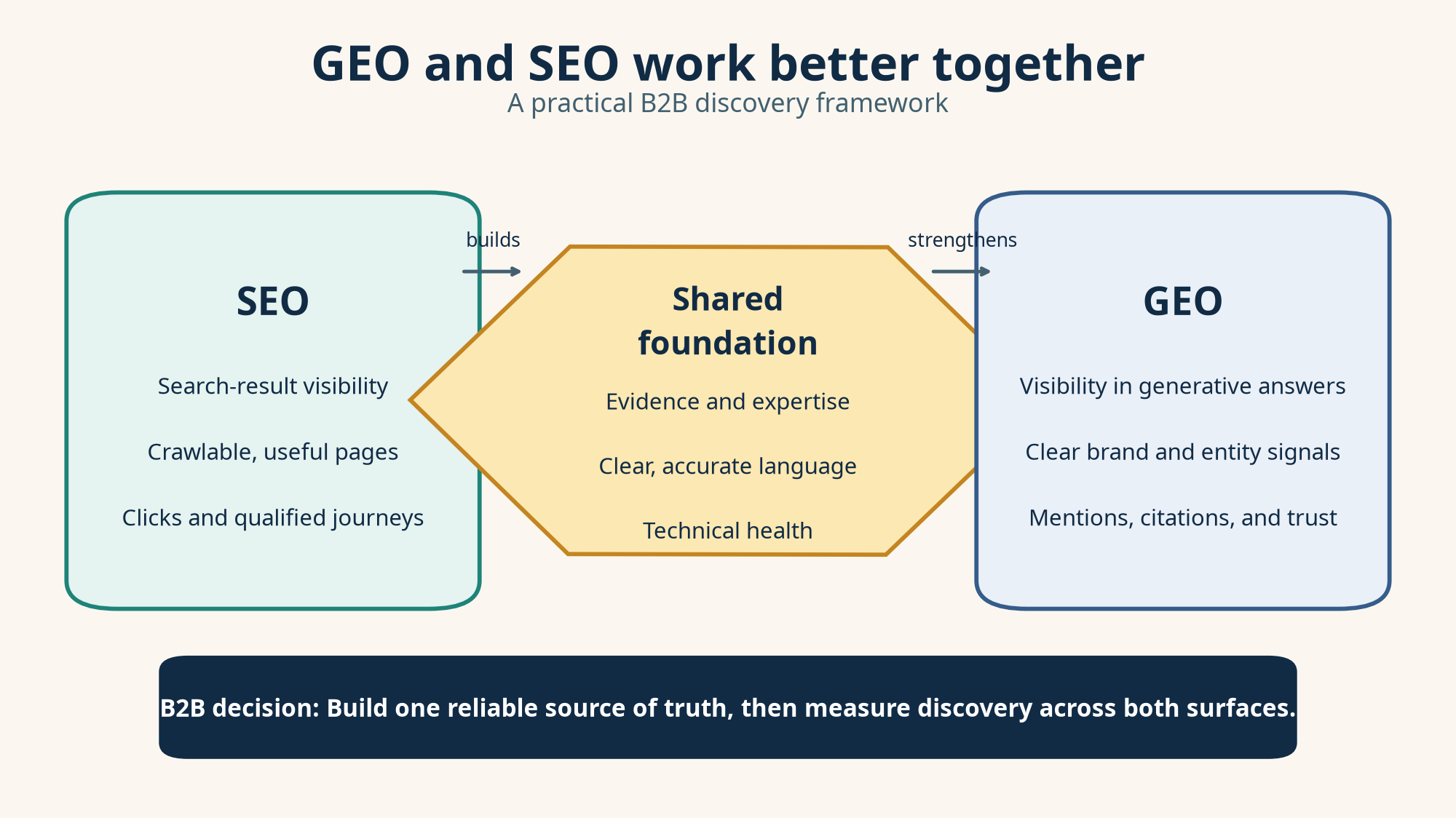
*SEO and GEO have distinct outcomes, but both rely on clear, credible, technically accessible information.*
What SEO does well
SEO has a direct job: make it easier for the right person to discover a useful page when they search. This includes technical accessibility, relevant page structure, clear titles and descriptions, internal linking, helpful content, and signals that support trust.
For B2B organisations, SEO is particularly valuable because it creates a durable library of owned material. A considered guide, comparison page, service page, or implementation resource can support research long after it is published. It gives the buyer something to share with a colleague, revisit during a procurement process, or use to judge whether the provider understands the problem.
SEO does not disappear because answer engines exist. Google describes generative-search optimisation as an extension of the existing work of creating helpful, technically accessible content. It explicitly advises against unnecessary special markup, artificial keyword variation, and other tactics that try to game a system rather than help a reader. [1]
What GEO changes
GEO asks a related but different question: when a buyer asks an answer engine about your category, your approach, or your company, is the answer accurate and useful?
Answer engines often summarise information from several sources. That means brand clarity matters. If your website, product pages, customer stories, partner pages, and thought-leadership content all describe the business differently, an answer engine has more opportunity to produce a muddled explanation.
Column Five makes a useful distinction for B2B: traditional SEO asks whether a page ranks for a query, while answer-engine work asks whether a generated description of the brand is one the company would stand behind. [2] That does not make GEO a separate content factory. It makes consistency a more pressing commercial issue.
The practical implication is straightforward. Write clear definitions. Support important claims. Give expert material a named author where appropriate. Keep your service descriptions consistent. Publish genuinely useful evidence rather than broad statements that could apply to anyone.
The scale still matters
There is a temptation to treat answer engines as a reason to abandon conventional search. That would be a mistake. In a comparison published in 2025, Contentful cited more than 14 billion daily Google searches and 37 million daily ChatGPT searches. The exact figures will change, but the strategic point remains: conventional search remains the larger discovery surface for most B2B teams. [3]
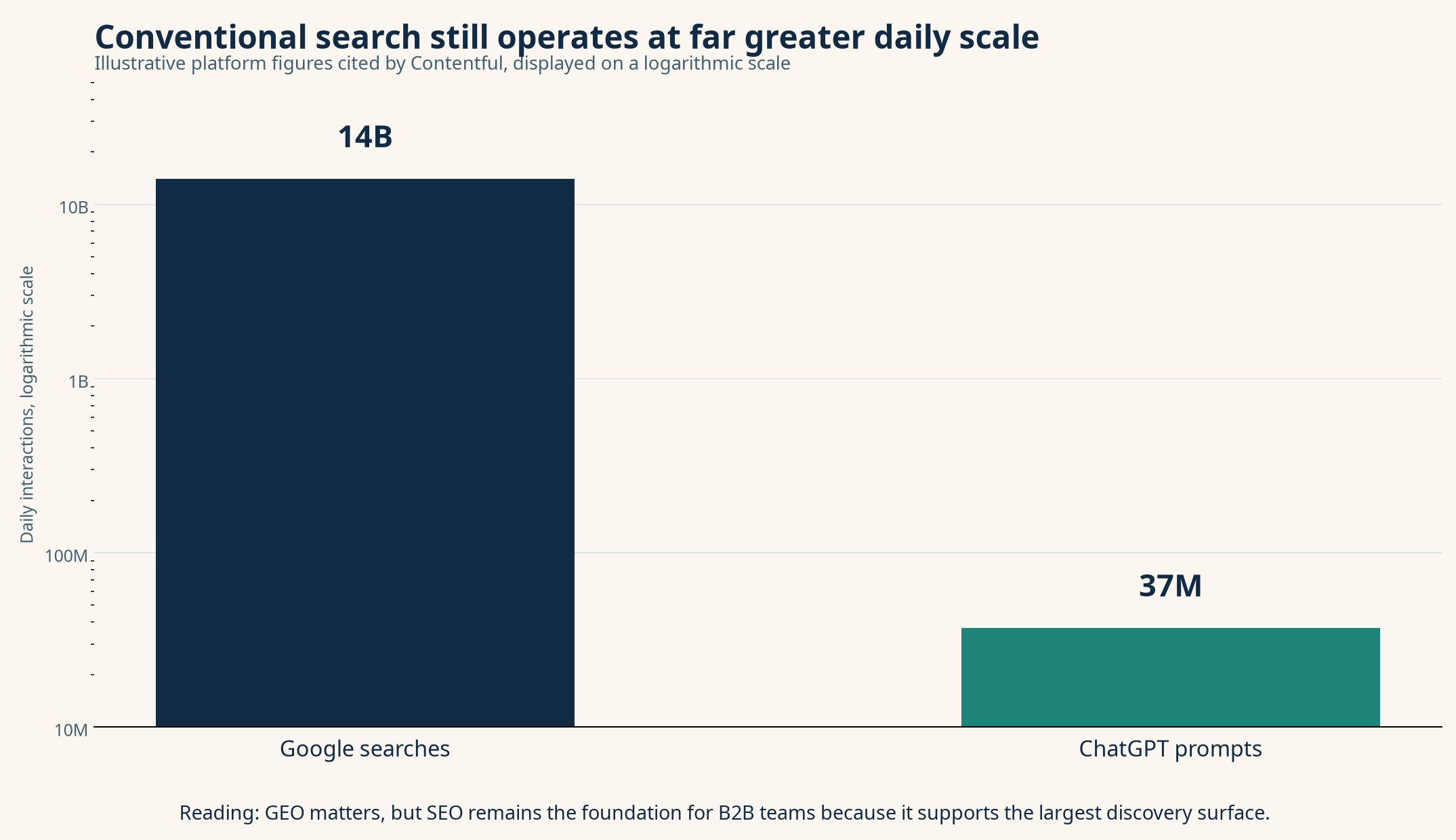
*Source: figures cited by Contentful in 2025. The logarithmic scale makes the large difference in platform volume visible without implying that every interaction has the same commercial value.*
GEO still matters because buyers may form a first impression before they ever click. They may ask an answer engine which providers serve a category, what a complex term means, or which approach suits their situation. The goal is not to replace SEO traffic with a vague count of mentions. The goal is to be useful and correctly represented wherever serious research happens.
The shared foundation is more important than the label
The best work for SEO and GEO is familiar:
| Shared practice | Why it helps SEO | Why it helps GEO |
|---|---|---|
| Original, evidence-backed material | Gives a page a reason to rank and earn links | Gives an answer engine something credible to reference |
| Clear definitions and headings | Helps people and search systems understand the page | Makes answers easier to interpret and summarise |
| Technical accessibility | Helps pages be crawled and used | Keeps the source material available and reliable |
| Consistent positioning | Reduces confusion across the site | Reduces conflicting signals about the brand |
| Regular updates | Protects relevance and accuracy | Prevents stale claims from shaping answer output |
Informa TechTarget describes the same split in practical terms: SEO brings technical precision and discoverability, while GEO benefits from conversational clarity and factual precision. [4] Neither needs shallow content. Neither benefits from claims that cannot be defended.
How should B2B teams measure the work?
SEO measurement is more mature. Rankings, impressions, clicks, organic conversions, and assisted journeys can be tracked with familiar tools. GEO measurement is still developing. A reasonable starting point is to run a stable set of buyer-relevant prompts across the answer engines your audience uses, then document brand inclusion, the accuracy of the description, competitor mentions, and referral quality over time.
Do not turn that into theatre. A single prompt is not a market. A screenshot of one favourable answer is not proof of a strategy. Look for patterns and connect them to real commercial signals, such as branded search, qualified referral traffic, relevant enquiries, and the consistency of how the brand is described.

*Measurement becomes useful when content, brand, and revenue teams agree on what a good discovery outcome looks like.*
Choose SEO first when the basics are weak
SEO should be the immediate priority if your important pages are hard to find, your service offering is unclear, the site has serious technical problems, or your content does not answer the questions buyers already ask. Those problems will limit both conventional visibility and answer-engine credibility.
Add GEO focus when the foundation is working
GEO deserves deliberate attention when your category is researched through answer engines, your brand story is inconsistent across public sources, buyers ask complex comparison questions, or you have credible expertise that is not being expressed in clear, citable material.
The first move is not a new tool. It is a content and brand audit. Ask a small group of buyer-relevant questions in the discovery surfaces that matter to your audience. Compare the answers with your intended positioning. Then improve the underlying source material before attempting any clever tactic.
The verdict: GEO is an extension of good SEO
Choose SEO as the operational foundation because it supports the largest discovery surface and improves the usability of the owned content you control. Add GEO as a discipline for clarity, authority, and answer-driven visibility once that foundation is sound.
The winning B2B approach is not “SEO or GEO.” It is one reliable body of evidence, pages that make sense to a real person, and a measurement model that follows the buyer beyond the initial click or mention. Raftika can help you identify where your current content is strong, where your brand story is drifting, and which improvements deserve priority.
Frequently asked questions
Is GEO replacing SEO?
No. GEO does not replace SEO. Google says its existing guidance remains relevant for generative search experiences, and reputable comparison sources consistently describe SEO as the foundation for discoverability and authority. [1] [2]
What is the difference between GEO and AEO?
The terminology is still unsettled. GEO usually refers to visibility in generative-engine outputs, while AEO often refers to visibility in answer-first search features. In practical B2B work, both emphasise clear, trustworthy, structured material that can be represented accurately.
Do I need special GEO markup?
Not as a shortcut. Use relevant structured data when it accurately represents the page. Do not add markup or create pages simply because someone claims it will force answer-engine visibility. Google specifically advises against unsupported GEO hacks. [1]
References
[1]: https://developers.google.com/search/docs/fundamentals/ai-optimization-guide "Google Search Central: AI features and your website" [2]: https://www.columnfivemedia.com/aeo-vs-seo/ "Column Five: AEO vs SEO and GEO" [3]: https://www.contentful.com/blog/generative-engine-optimization-seo/ "Contentful: What is generative engine optimization and how does it differ from SEO?" [4]: https://www.informatechtarget.com/blog/geo-vs-seo-a-marketers-guide-to-dual-optimization/ "Informa TechTarget: GEO vs SEO"
For a practical next step, explore B2B SEO, Generative Engine Optimization and AI Growth & Automation.